
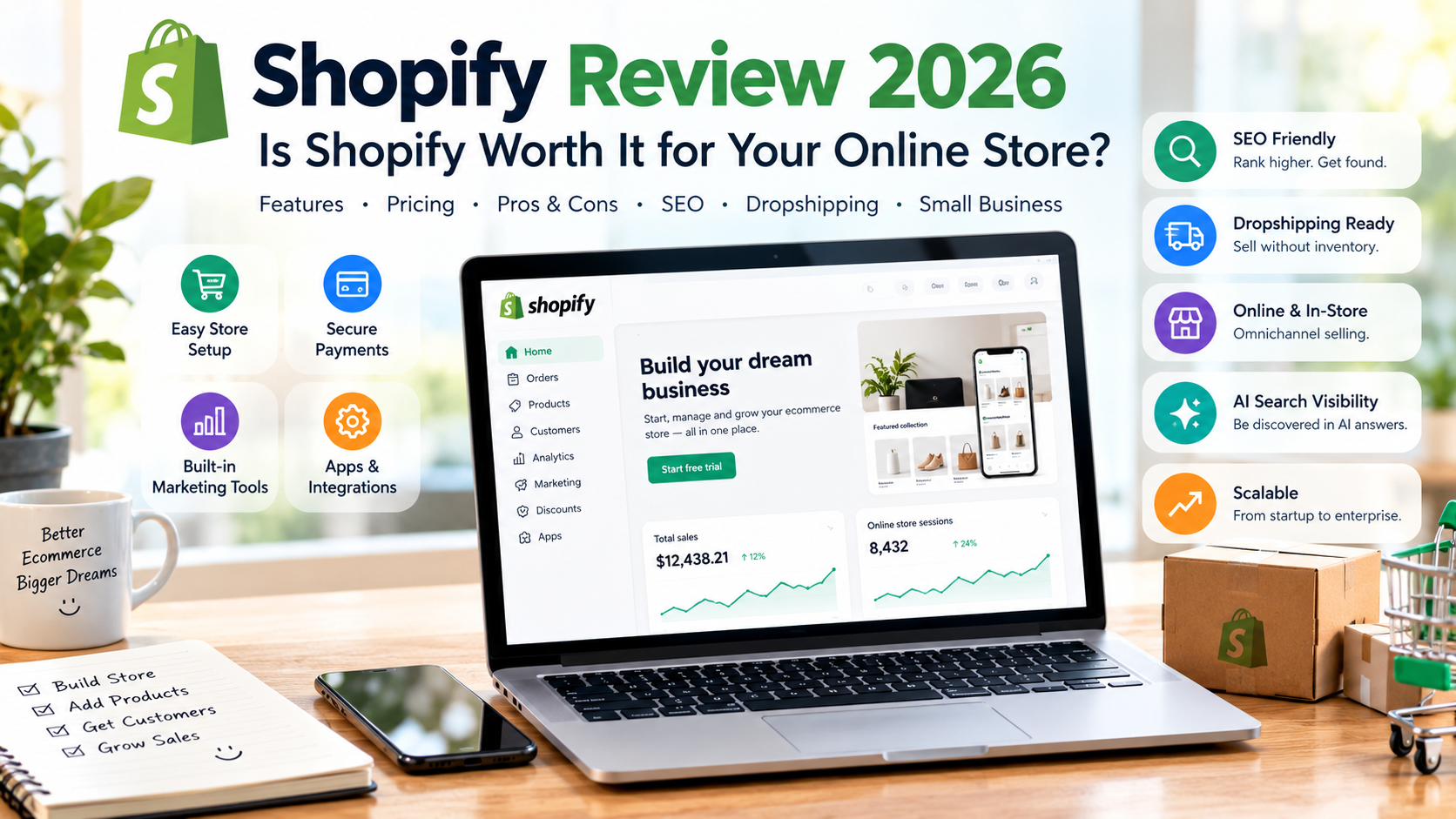
Is Shopify Worth It in 2026?
Yes, Shopify is worth considering if you want an ecommerce platform that makes it relatively easy to build, manage and scale an online store without having to manage the underlying website infrastructure yourself.
Shopify combines online store creation, product management, payments, checkout, inventory, marketing, analytics, selling through social channels and integrations in one platform.
It is particularly attractive to small businesses, ecommerce entrepreneurs, retailers, dropshippers, creators and growing brands that want to launch quickly and scale without building an ecommerce system from scratch.
However, Shopify isn’t perfect.
The monthly subscription, payment-related costs, apps and premium themes can add up. Businesses that want extensive control over their website infrastructure may also prefer alternatives such as WooCommerce.
So, is Shopify the right ecommerce platform for you?
Let’s take a closer look.
What Is Shopify?
Shopify is an ecommerce platform that allows businesses to create an online store and sell products through multiple channels.
Instead of purchasing web hosting, installing ecommerce software, configuring a database and managing technical infrastructure yourself, Shopify provides an integrated environment for running an online store.
Shopify provides themes, an app marketplace, payment processing options, ecommerce functionality, marketing tools and sales channels. Its plans support unlimited products and bandwidth, while additional functionality can be added through apps and integrations.
This makes Shopify particularly appealing to entrepreneurs who want to spend more time on products, marketing and customers and less time maintaining technical infrastructure.
Shopify Pricing: How Much Does Shopify Cost?
Shopify pricing depends on your plan, billing cycle, location and payment setup.
For businesses in Singapore, Shopify currently lists the following annual-billing prices:
| Shopify Plan | Annual-Billing Price | Best For |
|---|---|---|
| Basic | S$29/month | Solo entrepreneurs |
| Grow | S$99/month | Small teams |
| Advanced | S$399/month | Growing/global businesses |
| Plus | From US$2,300/month | Complex/high-volume businesses |
Shopify’s Singapore pricing page currently shows monthly rates of S$39, S$132 and S$531 respectively for Basic, Grow and Advanced when billed monthly.
The US pricing page currently lists Basic at US$29/month, Grow at US$79/month and Advanced at US$299/month when billed annually.
Shopify also advertises a current introductory offer of 3 days free followed by US$1/month for three months on its pricing pages, although promotional terms can change.
What about transaction fees?
Your total Shopify cost isn’t necessarily limited to the monthly subscription.
Payment processing rates vary by country and plan, and additional third-party transaction fees may apply depending on how payments are processed. Shopify itself notes that its plans can involve multiple rates and fees, including subscription, card processing and third-party transaction fees.
Long-tail keywords:
- Shopify pricing Singapore
- Shopify cost per month Singapore
- how much does Shopify cost for a small business
- Shopify monthly fees explained
- Shopify transaction fees Singapore
- cheapest Shopify plan for beginners
Shopify Features: What Do You Get?
One of Shopify’s biggest advantages is the breadth of ecommerce functionality available from one platform.
Depending on your plan and configuration, you can manage:
- Products
- Collections
- Inventory
- Orders
- Customers
- Payments
- Shipping
- Discounts
- Marketing
- Analytics
- Online storefront
- Social selling
- Marketplace selling
- Point of sale
- Apps and integrations
Shopify also supports selling through AI-powered channels, with its current plans highlighting the ability to sell in AI chats.
That last point is increasingly interesting for ecommerce businesses because product discovery is expanding beyond traditional search engines.
Shopify for Small Businesses
One of Shopify’s strongest use cases is the small business that wants to establish a professional ecommerce presence without hiring a development team to build everything from scratch.
A small business can use Shopify to:
- Create an online store
- Add products
- Configure payments
- Set up shipping
- Create product collections
- Publish content
- Run marketing campaigns
- Track sales
- Add apps as the business grows
The Basic plan is specifically positioned by Shopify for solo entrepreneurs.
This makes Shopify a particularly attractive option for entrepreneurs who are moving from Instagram, marketplaces or offline retail into their own ecommerce store.
Long-tail keywords:
- Shopify for small business
- best Shopify plan for small business
- Shopify for small online businesses
- Shopify for entrepreneurs
- Shopify ecommerce platform for beginners
- is Shopify good for a small business
Shopify for Dropshipping
Shopify is also frequently associated with dropshipping.
The platform itself doesn’t mean that every Shopify store is a dropshipping business. Instead, Shopify provides the ecommerce infrastructure while third-party apps and suppliers can be used to support different fulfillment models.
This can make Shopify appealing to entrepreneurs who want to test products without building a custom ecommerce system.
However, there is an important distinction:
Shopify can make launching a dropshipping store easier, but it doesn’t make finding profitable products or acquiring customers easy.
Your success will still depend on product selection, margins, supplier reliability, customer service, branding, advertising and organic traffic.
Long-tail keywords:
- Shopify dropshipping review
- is Shopify good for dropshipping
- best Shopify platform for dropshipping
- Shopify dropshipping for beginners
- how to start a Shopify dropshipping store
- Shopify vs other ecommerce platforms for dropshipping
Shopify SEO: Is Shopify Good for SEO?
Yes. Shopify can be a strong platform for SEO, but having a Shopify store doesn’t automatically make the store rank well.
Shopify includes built-in SEO functionality and provides control over important elements such as page titles, meta descriptions and image alt text.
Shopify’s own SEO documentation recommends using relevant keywords in page titles, descriptions, alt text and page content. It also provides guidance for optimizing site structure and submitting your sitemap to Google Search Console.
Shopify also automatically handles several technical aspects of store structure, including a logical hierarchy and readable URL structure.
However, ranking a Shopify store still requires a proper SEO strategy.
You need to consider:
- Keyword research
- Search intent
- Product-page optimization
- Category/collection pages
- Internal linking
- Technical SEO
- Page speed
- Content marketing
- Digital PR and backlinks
- Local SEO where relevant
- Product structured data
- AI-search visibility
In other words:
Shopify gives you the SEO foundation. You still need to build the SEO strategy.
Shopify and GEO/AEO: Is Shopify Ready for AI Search?
This is an increasingly important question for ecommerce businesses.
Traditional SEO focuses heavily on ranking web pages in search engines.
GEO — Generative Engine Optimization — focuses on increasing the likelihood that your business, products and content are represented in AI-generated answers.
AEO — Answer Engine Optimization — focuses on making information easy for answer engines to understand and use when answering specific questions.
Shopify is moving further into this area. Its current pricing pages highlight the ability to sell in AI chats, while Shopify’s SEO documentation now includes guidance specifically around optimizing your store for AI.
For Shopify merchants, this creates an opportunity to optimize:
- Product descriptions
- Collection pages
- Buying guides
- FAQs
- Comparison pages
- Product reviews
- Brand information
- Shipping and returns information
- Expert content
- Original product information
For example, instead of publishing a product page that simply says:
“Premium wireless headphones with excellent sound.”
A stronger ecommerce page could answer:
Who are these headphones best for?
Are they suitable for working from home?
How long does the battery last?
How do they compare with similar headphones?
Are they suitable for travel?
This type of useful, specific information can potentially make your content more valuable to both human shoppers and answer engines.
Shopify POS: Can You Sell Online and In-Store?
Yes.
Shopify isn’t limited to online stores.
Shopify POS allows businesses to connect physical retail sales with their online operations.
Its POS functionality includes:
- In-store checkout
- Inventory management
- Customer management
- Staff permissions
- Payments
- Reporting
- Hardware
- Online and offline selling workflows
Shopify describes its POS system as an omnichannel platform that can connect sales across physical stores, online channels, social media and marketplaces.
This is particularly useful for retailers that have both an ecommerce website and physical locations.
For example, a Singapore fashion retailer could sell through:
Website → Physical store → Pop-up events → Social media → Marketplaces
while maintaining centralized product and inventory management.
Shopify Pros and Cons
Shopify Pros
1. Easy to launch
Shopify significantly reduces the technical work involved in launching an ecommerce store.
2. Strong ecommerce ecosystem
There are numerous themes, apps, integrations and services available through the Shopify ecosystem.
3. Scalable
You can start with a basic plan and move to more advanced plans as your requirements grow.
4. Strong checkout experience
Shopify places significant emphasis on its ecommerce checkout and conversion experience.
5. Omnichannel selling
You can sell online, in-store, through social channels and marketplaces.
6. Good SEO foundation
Shopify provides built-in SEO capabilities and controls for many important on-page elements.
7. Large app ecosystem
Apps allow merchants to extend Shopify beyond its core functionality.
Shopify Cons
1. Monthly subscription cost
Unlike some self-hosted ecommerce options, Shopify requires an ongoing subscription.
2. Apps can increase costs
A store that requires numerous third-party apps can become significantly more expensive.
3. Transaction costs need consideration
Depending on your payment configuration and location, payment and transaction-related fees can affect your margins.
4. Less technical control than self-hosted platforms
Businesses wanting deep server-level control may prefer WooCommerce or another self-hosted solution.
5. Customization can become complex
Highly customized stores may require Shopify development expertise.
Shopify vs WooCommerce: Which Is Better?
The answer depends on what you value most.
| Feature | Shopify | WooCommerce |
|---|---|---|
| Ease of setup | Excellent | Moderate |
| Hosting | Included | Usually separate |
| Technical control | Moderate | High |
| Ecommerce functionality | Excellent | Excellent |
| App/plugin ecosystem | Excellent | Excellent |
| SEO flexibility | Good | Excellent |
| Maintenance | Lower | Higher |
| Beginner friendly | Excellent | Moderate |
| Scalability | Excellent | Excellent |
| Best for | Convenience & growth | Flexibility & control |
Choose Shopify if you want an easier managed ecommerce platform.
Choose WooCommerce if you already use WordPress or want greater control over your hosting and website environment.
Neither platform is automatically better for every business.
Who Should Use Shopify?
Shopify is particularly suitable for:
- Ecommerce beginners
- Small businesses
- Retailers
- Product brands
- Dropshipping entrepreneurs
- Direct-to-consumer brands
- Creators selling physical products
- Businesses with physical and online stores
- Growing ecommerce businesses
- International brands
It may be less suitable if you want a completely self-hosted website with maximum technical control or if your website is primarily informational rather than ecommerce-focused.
Is Shopify Worth It for a Singapore Business?
For many Singapore ecommerce businesses, Shopify can be a practical option because it provides a relatively straightforward way to establish an online store and expand into multiple sales channels.
The key consideration isn’t simply the monthly subscription.
Singapore merchants should evaluate:
- Payment processing costs
- Shipping integrations
- GST considerations
- Local delivery options
- Inventory management
- Marketplace integrations
- Customer support
- International expansion
- SEO requirements
- App costs
The right Shopify plan ultimately depends on your sales volume and operational requirements.
Long-tail keywords:
- Shopify Singapore review
- Shopify pricing Singapore 2026
- is Shopify good for Singapore businesses
- best ecommerce platform Singapore small business
- Shopify for Singapore online store
- Shopify vs WooCommerce Singapore
Shopify Review: Our Verdict
Overall Rating: 4.5/5
Shopify remains one of the strongest ecommerce platforms for entrepreneurs and businesses that want to launch and grow an online store without taking on the technical responsibilities of a self-hosted ecommerce system.
Its biggest strengths are ease of use, scalability, ecommerce functionality, integrations, checkout, omnichannel selling and its extensive ecosystem.
The main drawbacks are cost and the possibility that subscriptions, apps and transaction-related fees can add up as your business becomes more sophisticated.
For a beginner launching an ecommerce business, Shopify Basic is a logical starting point.
For a growing team, Grow can provide additional staff capacity.
For businesses operating internationally or requiring more advanced functionality, Advanced may make more sense.
And for large, complex organizations, Shopify Plus is the enterprise option.
Our recommendation
Shopify is best for entrepreneurs and businesses that prioritize simplicity, speed and scalability.
If you want maximum technical control and already have a WordPress-based website, WooCommerce may be worth considering.
But if your priority is:
“I want to build an ecommerce store and start selling without dealing with all the technical infrastructure myself,”
Shopify is one of the platforms I’d put near the top of the shortlist.
Frequently Asked Questions About Shopify
Is Shopify good for beginners?
Yes. Shopify is designed to reduce much of the technical complexity involved in launching an ecommerce store, making it one of the more beginner-friendly ecommerce platforms.
How much does Shopify cost per month?
In Singapore, Shopify currently lists Basic at S$29/month, Grow at S$99/month and Advanced at S$399/month when billed annually. Monthly billing is currently higher.
Is Shopify worth it for a small business?
Yes, particularly if the business sells physical or digital products and wants a managed ecommerce platform that can grow with the business.
Is Shopify good for SEO?
Yes. Shopify provides built-in SEO capabilities and allows merchants to optimize page titles, meta descriptions, image alt text, URLs and content. However, achieving strong rankings still requires a broader SEO strategy.
Is Shopify better than WooCommerce?
Neither is universally better. Shopify is generally easier to manage, while WooCommerce offers greater control and flexibility for WordPress users.
Can I use Shopify for dropshipping?
Yes. Shopify can provide the ecommerce infrastructure for a dropshipping business, although you will still need reliable suppliers, profitable products, effective marketing and good customer service.
Can Shopify sell products in physical stores?
Yes. Shopify POS allows merchants to connect physical retail sales with their online Shopify store, including inventory, payments and customer management.
Can Shopify help with AI search visibility?
Shopify is increasingly incorporating AI-related commerce capabilities, including selling through AI chats. Merchants should also optimize their product and informational content with clear answers, structured information and original expertise to improve their overall search visibility.
Affiliate Disclosure
This article may contain affiliate links. If you purchase Shopify or another product through an affiliate link, I may earn a commission at no additional cost to you.
I only recommend tools and platforms that I believe may be useful for entrepreneurs, small businesses and ecommerce operators. Pricing, features, promotional offers and affiliate terms can change, so check the provider’s current terms before purchasing.