
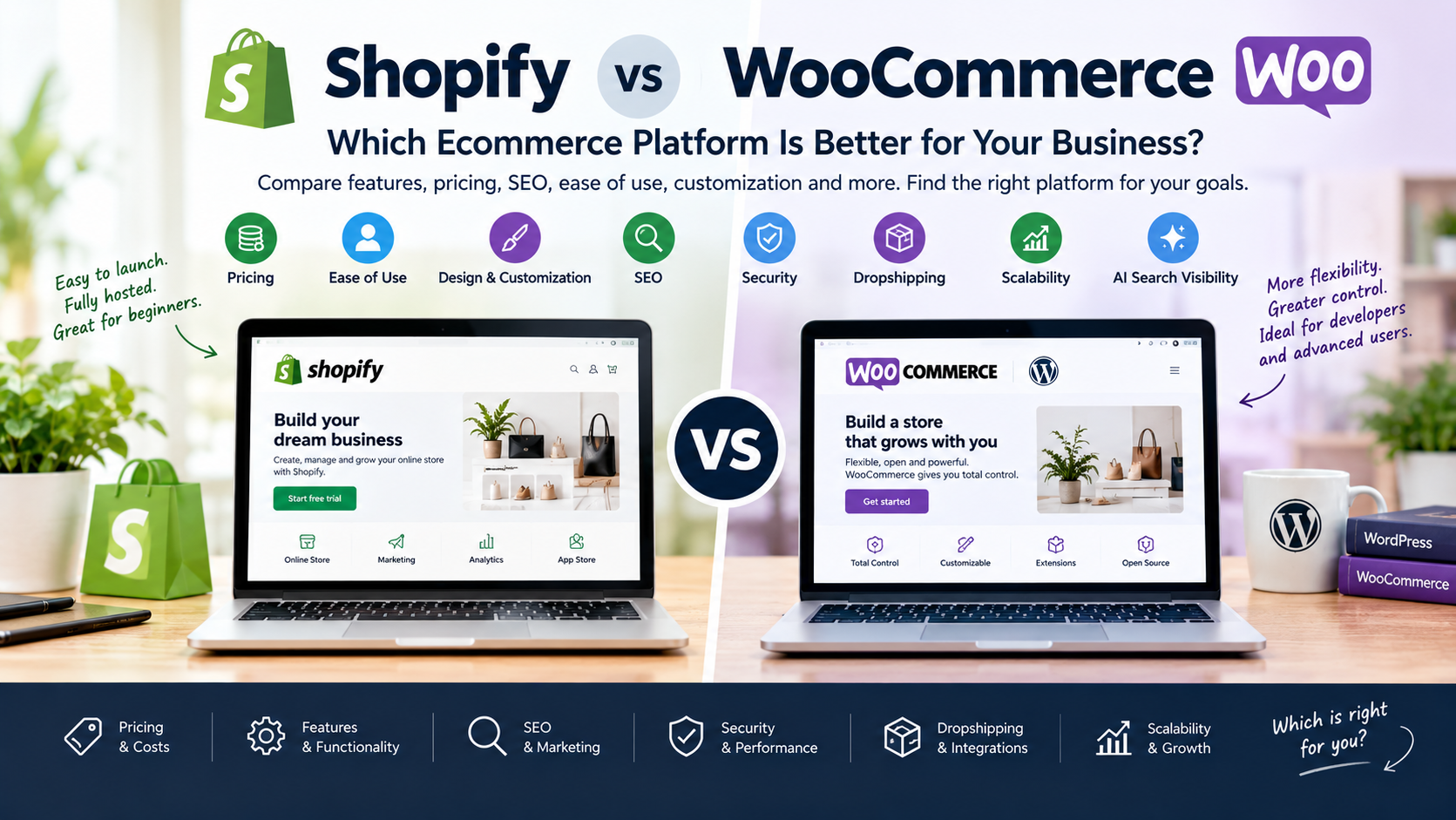
Shopify vs WooCommerce: Which Is Better?
Shopify is generally better for beginners and businesses that want a managed ecommerce platform, while WooCommerce is better for businesses that want greater control, flexibility and WordPress integration.
Both platforms can support successful online stores, but they approach ecommerce differently.
Shopify is a hosted ecommerce platform. It provides the main infrastructure, hosting, checkout, security features and store management tools in one subscription.
WooCommerce is a free, open-source ecommerce platform built for WordPress. You choose your hosting, payment providers, extensions and additional functionality.
The best choice depends on your technical experience, budget, product range, marketing strategy and long-term business goals.
This guide compares Shopify and WooCommerce across the most important factors, including:
- Pricing
- Ease of use
- Design and customization
- SEO
- Security
- Performance
- Dropshipping
- Payments
- Scalability
- Small business suitability
- AI search visibility
Shopify vs WooCommerce: Quick Comparison
| Feature | Shopify | WooCommerce |
|---|---|---|
| Platform type | Hosted ecommerce platform | WordPress ecommerce plugin |
| Ease of setup | Very easy | Requires more configuration |
| Hosting | Included | Purchased separately |
| Monthly platform fee | Subscription required | Core platform is free |
| Customization | Good, with some limitations | Highly flexible |
| Technical maintenance | Mostly managed | Store owner responsibility |
| SEO flexibility | Good | Excellent |
| Security management | Largely managed | Requires ongoing attention |
| Themes and extensions | Large app ecosystem | Large plugin ecosystem |
| Best for | Beginners and growing brands | WordPress users and advanced customization |
| Dropshipping | Supported through apps | Supported through plugins |
| Scalability | Strong | Strong with suitable hosting and development |
What Is Shopify?
Shopify is a hosted ecommerce platform that allows businesses to create and manage online stores without having to arrange separate hosting or manage most server-level technical tasks.
Shopify includes tools for:
- Product management
- Inventory
- Checkout
- Payments
- Shipping
- Discounts
- Customer accounts
- Analytics
- Marketing
- Social selling
- Marketplace selling
- Point-of-sale retail
Shopify’s Singapore pricing page currently lists Basic at S$29 per month, Grow at S$99 per month and Advanced at S$399 per month when billed annually. Monthly billing is higher. Shopify also includes online selling, social and marketplace selling, AI-chat selling and integrations with thousands of apps.
Shopify is designed to reduce the technical complexity of running an online store.
This makes it particularly attractive to:
- Ecommerce beginners
- Small businesses
- Product brands
- Retailers
- Dropshipping entrepreneurs
- Creators
- Businesses expanding from physical retail to ecommerce
What Is WooCommerce?
WooCommerce is a free, open-source ecommerce platform for WordPress.
Unlike Shopify, WooCommerce does not require a platform subscription for its core software. However, you will generally need to pay for web hosting, a domain name, payment processing, premium themes and optional extensions.
WooCommerce’s official pricing page explains that the core platform is free, with hosting commonly costing between approximately US$25 and US$350 per month depending on store requirements. Extensions are typically purchased separately, with many costing between US$29 and US$299 per year.
WooCommerce is attractive to businesses that want control over:
- Hosting
- Website code
- Database
- Design
- Plugins
- Checkout
- Product functionality
- Content structure
- SEO
- Integrations
Because WooCommerce operates within WordPress, it is especially useful for businesses that want to combine ecommerce with blogging, content marketing and advanced SEO.
Shopify vs WooCommerce Pricing
Pricing is one of the biggest differences between Shopify and WooCommerce.
Shopify Pricing
Shopify uses a subscription model.
In Singapore, its current annual-billing prices are:
- Basic: S$29 per month
- Grow: S$99 per month
- Advanced: S$399 per month
- Shopify Plus: From US$2,300 per month
Shopify also charges payment processing fees, and additional third-party transaction fees may apply depending on your payment setup. Its current Singapore pricing page lists card rates from 3.2% plus S$0.50 for Basic, 3.1% plus S$0.50 for Grow and 3% plus S$0.50 for Advanced.
Apps and premium themes may create additional monthly or annual costs.
WooCommerce Pricing
WooCommerce’s core software is free, but you need to budget for:
- Domain registration
- Web hosting
- SSL or security services
- Premium themes
- Paid plugins
- Payment processing
- Website maintenance
- Developer support
WooCommerce may be cheaper at a basic level, especially if you already have a WordPress website and hosting account.
However, a heavily customized WooCommerce store can become expensive because you may need developers, premium plugins and more powerful hosting.
Which Is Cheaper?
WooCommerce is usually cheaper in terms of platform fees, while Shopify is often more predictable in terms of ongoing management costs.
Shopify is easier to budget for because many core services are included.
WooCommerce gives you more control over where money is spent, but the total cost depends on your hosting, plugins and maintenance requirements.
Long-tail keywords:
- Shopify vs WooCommerce pricing
- Shopify vs WooCommerce cost for small business
- cheapest ecommerce platform for small business
- Shopify monthly fees vs WooCommerce hosting
- WooCommerce hidden costs
- Shopify transaction fees vs WooCommerce fees
Shopify vs WooCommerce Ease of Use
Shopify Ease of Use
Shopify is generally easier for beginners.
After creating an account, you can choose a theme, add products, configure payments and begin customizing your store.
Shopify manages much of the technical infrastructure, including hosting and many security-related responsibilities.
This allows business owners to focus on:
- Product sourcing
- Branding
- Marketing
- Customer service
- Order fulfillment
- Sales growth
WooCommerce Ease of Use
WooCommerce is more flexible but usually requires more setup.
You may need to:
- Purchase hosting
- Install WordPress
- Install WooCommerce
- Configure a theme
- Set up payment gateways
- Configure shipping
- Install security tools
- Manage updates
- Configure backups
- Troubleshoot plugin conflicts
WordPress itself is user-friendly, but running a complete WooCommerce store requires more technical responsibility.
Winner for Ease of Use
Shopify wins for beginners and business owners who want to launch quickly.
WooCommerce is better for users who are comfortable managing WordPress or have access to a developer.
Shopify vs WooCommerce Design and Customization
Shopify offers a wide selection of themes and apps. Its themes are generally designed around ecommerce usability, mobile responsiveness and conversion-focused layouts.
You can customize:
- Homepage sections
- Product pages
- Collection pages
- Navigation
- Fonts
- Colors
- Images
- Checkout elements
- Marketing sections
However, advanced customization may require knowledge of Shopify’s Liquid templating language or help from a Shopify developer.
WooCommerce offers more control because it operates inside WordPress.
You can customize almost every part of the website, including:
- Product layouts
- Checkout
- Cart
- Blog
- Navigation
- Database
- Theme code
- Plugins
- Custom functionality
Winner for Customization
WooCommerce wins for advanced customization and technical control.
Shopify is better if you want attractive ecommerce design without managing a complicated development environment.
Shopify vs WooCommerce SEO
Both platforms can support strong SEO.
However, they offer different levels of control.
Shopify SEO
Shopify includes built-in SEO functionality such as:
- Editable page titles
- Meta descriptions
- Image alt text
- Automatic XML sitemaps
- Canonical tags
- Robots.txt controls
- SSL
- Product structured data through themes
- SEO apps
Shopify’s official documentation states that the platform automatically generates sitemaps and robots.txt files, adds canonical tags and provides controls for titles, descriptions, URLs and image alt text.
Shopify is therefore capable of ranking well, but store owners still need to perform keyword research, optimize product pages, create useful content and earn backlinks.
WooCommerce SEO
WooCommerce benefits from WordPress’s strong content management and SEO ecosystem.
You can use plugins for:
- On-page SEO
- XML sitemaps
- Schema markup
- Breadcrumbs
- Redirects
- Internal linking
- Content optimization
- Image optimization
- Technical SEO
WooCommerce also provides more control over URLs, website structure, content templates and technical implementation.
Winner for SEO
WooCommerce is the stronger option for advanced SEO control, while Shopify provides a simpler SEO foundation.
For most small businesses, the quality of the content and marketing strategy will matter more than the platform alone.
Long-tail keywords:
- Shopify vs WooCommerce SEO
- best ecommerce platform for SEO
- Shopify SEO limitations
- WooCommerce SEO for beginners
- best SEO platform for ecommerce website
- Shopify or WooCommerce for blogging and SEO
Shopify vs WooCommerce for GEO and AEO
GEO stands for Generative Engine Optimization, while AEO stands for Answer Engine Optimization.
Both focus on making your website easier for search engines and AI-powered answer systems to understand.
Neither Shopify nor WooCommerce automatically guarantees visibility in AI-generated answers.
Your results will depend on:
- Original content
- Product information
- Brand authority
- Reviews
- Structured data
- Clear answers
- Helpful buying guides
- External mentions
- Customer experience
- Website accessibility
Shopify is increasingly adding AI commerce capabilities, including the ability to sell in AI chats.
WooCommerce, meanwhile, provides greater technical flexibility for implementing custom structured data, content systems and integrations.
For either platform, merchants should create content that answers questions such as:
- Which product is best for beginners?
- What is the difference between two product models?
- How much does delivery cost?
- Is this product suitable for Singapore weather?
- How does this product compare with alternatives?
- What are the product’s main limitations?
- How should customers use or maintain it?
Winner for GEO and AEO
WooCommerce offers more technical flexibility, but Shopify may be easier for businesses that want built-in commerce capabilities and a managed platform.
The most important factor is useful, trustworthy and well-structured content.
Shopify vs WooCommerce for Dropshipping
Both Shopify and WooCommerce can support dropshipping.
Shopify is often easier for beginners because its app ecosystem makes it relatively simple to connect with suppliers, import products and automate parts of the fulfillment process.
WooCommerce can also support dropshipping through WordPress plugins and supplier integrations.
The platform itself, however, does not determine whether a dropshipping business will succeed.
Success depends on:
- Product selection
- Supplier reliability
- Delivery times
- Product margins
- Advertising costs
- Customer support
- Product quality
- Returns management
- Branding
Winner for Dropshipping
Shopify is usually the easier choice for beginners, while WooCommerce may be attractive to experienced users who want more control over costs and customization.
Long-tail keywords:
- Shopify vs WooCommerce for dropshipping
- best ecommerce platform for dropshipping beginners
- WooCommerce dropshipping review
- Shopify dropshipping costs
- Shopify or WooCommerce for product sourcing
Shopify vs WooCommerce Security
Shopify manages much of the security infrastructure for you.
This reduces the number of technical tasks store owners need to perform.
You still need to manage:
- Account security
- Strong passwords
- Staff permissions
- Fraud prevention
- Customer data
- App permissions
WooCommerce security is more dependent on your hosting provider, WordPress configuration, plugins and maintenance practices.
You need to manage:
- WordPress updates
- Plugin updates
- Theme updates
- Backups
- Malware protection
- Firewall configuration
- SSL
- User permissions
Winner for Security Management
Shopify is generally easier for business owners who do not want to manage technical security tasks.
WooCommerce can also be secure, but it requires more responsibility and regular maintenance.
Shopify vs WooCommerce Performance
The performance of either platform depends on how the store is built and maintained.
Shopify provides managed infrastructure, but excessive apps, large images and poorly optimized themes can still affect performance.
WooCommerce performance depends heavily on:
- Hosting quality
- Plugin efficiency
- Theme quality
- Database size
- Caching
- Image optimization
- Content delivery networks
- Technical configuration
A well-optimized WooCommerce store can be extremely fast. A poorly configured WooCommerce store can become slow and difficult to maintain.
Winner for Performance
Shopify is generally easier to keep stable, while WooCommerce offers more control for technical optimization.
For both platforms, monitor mobile performance, Core Web Vitals, image sizes and checkout usability.
Shopify vs WooCommerce for Small Businesses
Shopify is often the better choice for a small business that:
- Wants to launch quickly
- Has limited technical experience
- Needs a reliable checkout
- Wants predictable management
- Plans to sell through multiple channels
- Does not want to manage hosting
WooCommerce may be better for a small business that:
- Already uses WordPress
- Has an existing content-driven website
- Wants extensive design control
- Needs custom product functionality
- Has access to a developer
- Wants more control over hosting and expenses
Best Choice for Most Beginners
For a first-time ecommerce entrepreneur, Shopify is usually the safer starting point.
For an established WordPress business with advanced content and customization requirements, WooCommerce may provide better long-term flexibility.
Shopify vs WooCommerce for Singapore Businesses
Singapore businesses should evaluate more than just the platform subscription.
Important considerations include:
- Local payment gateways
- GST requirements
- Delivery and fulfillment
- Inventory locations
- Customer support
- Mobile shopping experience
- Marketplace integrations
- International expansion
- Multi-currency selling
- Local SEO
Shopify supports localized selling features such as local currencies, translated storefronts, local domains and international market configuration. Some capabilities require Shopify Payments or specific plans.
WooCommerce can also support Singapore-focused ecommerce through payment gateway plugins, shipping integrations and local service providers.
Best Choice for Singapore
Shopify is a strong option for businesses that want a managed ecommerce system and international selling features. WooCommerce is attractive for businesses that want a highly customized WordPress website with local integrations.
Long-tail keywords:
- Shopify vs WooCommerce Singapore
- best ecommerce platform Singapore small business
- Shopify pricing Singapore
- WooCommerce Singapore payment gateway
- best online store platform for Singapore business
- Shopify or WooCommerce for Singapore ecommerce
Shopify vs WooCommerce: Pros and Cons
Shopify Pros
- Easy to launch
- Hosting included
- Managed infrastructure
- Strong checkout
- Large app ecosystem
- Good scalability
- Reliable ecommerce features
- Suitable for beginners
- Supports online and physical selling
Shopify Cons
- Monthly subscription required
- Apps can increase costs
- Payment-related fees may apply
- Less technical control
- Advanced customization may require developers
- Some features depend on plan or app
WooCommerce Pros
- Free core platform
- Open-source flexibility
- Excellent WordPress integration
- Strong SEO potential
- Extensive plugin ecosystem
- Greater control over hosting and code
- Flexible product and checkout customization
- No WooCommerce platform revenue share
WooCommerce Cons
- Hosting is separate
- More technical maintenance
- Plugin conflicts can occur
- Security requires ongoing attention
- Costs can increase with premium extensions
- Advanced stores may require developer support
Final Verdict: Should You Choose Shopify or WooCommerce?
Choose Shopify if you want:
- A beginner-friendly ecommerce platform
- Faster setup
- Managed hosting
- A reliable checkout
- Less technical maintenance
- A scalable store for a growing brand
Choose WooCommerce if you want:
- Maximum flexibility
- WordPress integration
- Greater SEO and content control
- Custom product functionality
- Control over hosting and website code
- A highly customized ecommerce website
Overall Recommendation
For most first-time store owners, Shopify is the better starting point because it reduces technical complexity and allows you to focus on products, marketing and customers.
For businesses already using WordPress or requiring advanced customization, WooCommerce may be the better long-term choice.
The most important point is that neither platform guarantees sales, rankings or profitability.
Your results will depend on product-market fit, pricing, customer experience, website performance, SEO, content marketing, advertising and consistent optimization.
Frequently Asked Questions
Is Shopify better than WooCommerce?
Shopify is generally better for beginners and businesses that want a managed ecommerce platform. WooCommerce is better for businesses that want more control, customization and WordPress integration.
Is WooCommerce cheaper than Shopify?
WooCommerce has no monthly platform fee, but you must pay for hosting, extensions, security and maintenance. Shopify has a monthly subscription but includes more infrastructure and management features.
Which is better for SEO, Shopify or WooCommerce?
WooCommerce offers more advanced technical SEO flexibility, while Shopify provides a simpler built-in SEO foundation. Both can rank well when properly optimized.
Is Shopify or WooCommerce better for dropshipping?
Shopify is usually easier for beginners because of its app ecosystem. WooCommerce may be more flexible for experienced users who want greater control over costs and integrations.
Which platform is better for a small business?
Shopify is often the best choice for small businesses that want to launch quickly and avoid technical maintenance. WooCommerce may be better if the business already uses WordPress.
Can Shopify and WooCommerce rank in Google?
Yes. Both platforms can rank in Google. Rankings depend on content quality, search intent, technical SEO, backlinks, user experience and website authority.
Which platform is better for AI search visibility?
Neither platform automatically guarantees GEO or AEO success. WooCommerce offers more technical flexibility, while Shopify provides managed ecommerce features and growing AI-commerce functionality.
Is Shopify suitable for a Singapore ecommerce business?
Yes. Shopify supports online selling, localized storefronts, international markets and multiple sales channels. Singapore businesses should evaluate payment fees, shipping, GST and app costs before choosing a plan.
Affiliate Disclosure
This article may contain affiliate links. If you purchase Shopify, WooCommerce-related products or another service through an affiliate link, I may earn a commission at no additional cost to you.
Pricing, features, payment fees and affiliate terms can change. Always review the provider’s current information before making a purchasing decision.