
What Are the Best Digital Marketing Tools for Small Businesses?
The best digital marketing tools for small businesses depend on what you are trying to achieve.
For most businesses, a practical digital marketing stack should cover SEO, website analytics, content creation, social media, email marketing, lead generation and customer management.
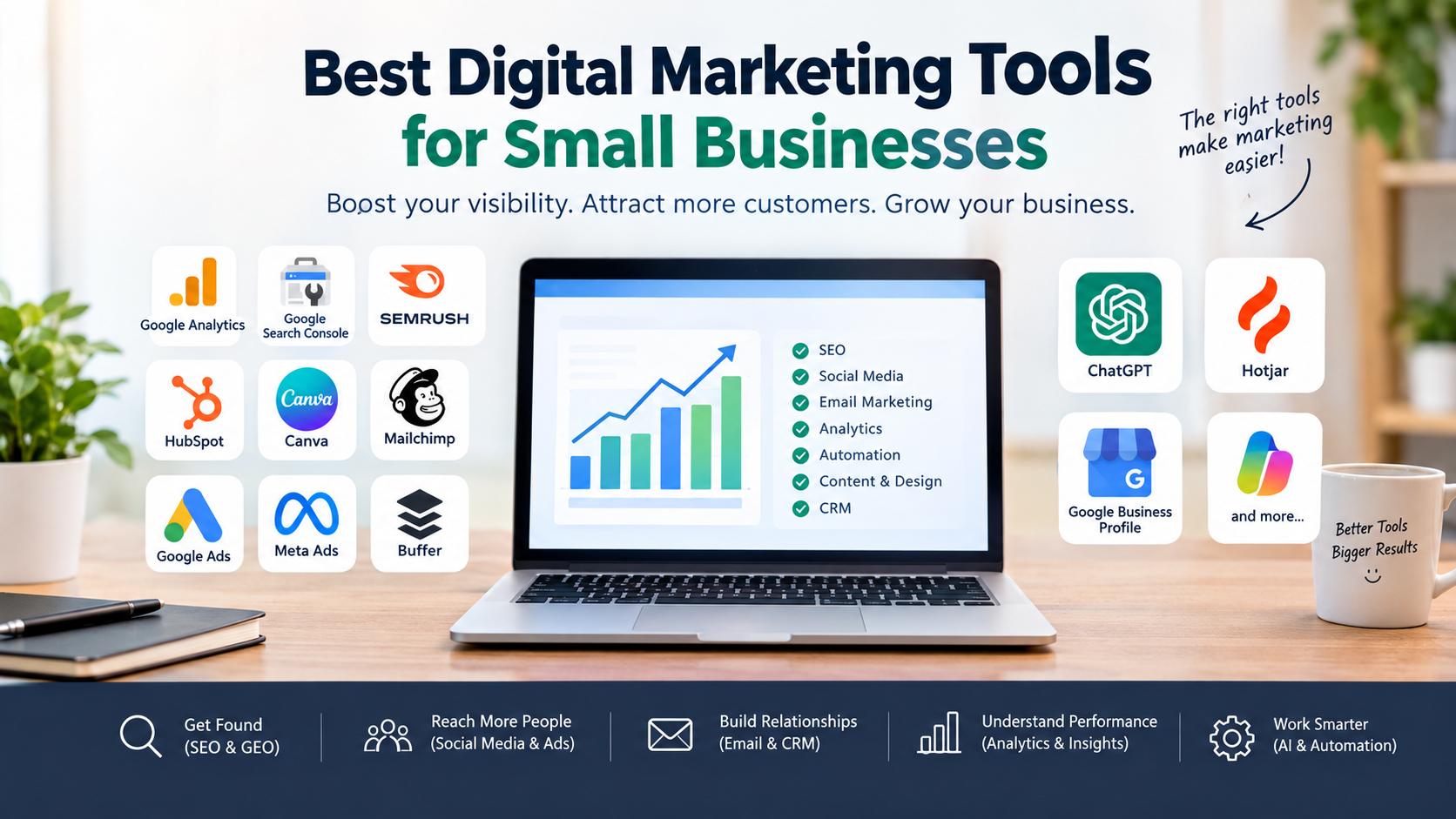
Some of the best digital marketing tools to consider in 2026 include:
- HubSpot – CRM, marketing automation and lead generation
- Semrush – SEO, competitor research and AI search visibility
- Google Analytics – Website and conversion analytics
- Google Search Console – Google Search performance and technical SEO
- Canva – Social media and marketing design
- Buffer – Social media scheduling and management
- Mailchimp – Email marketing and automation
- Google Ads – Paid search advertising
- Meta Ads Manager – Facebook and Instagram advertising
- Hotjar – Website behavior and conversion insights
- ChatGPT – AI-assisted content and marketing workflows
- Google Business Profile – Local search visibility
You don’t necessarily need all 12.
The smartest approach is to choose tools based on your marketing objectives, budget and current stage of growth.
1. HubSpot — Best All-in-One Marketing Platform
Best for: CRM, lead generation, marketing automation and customer management
HubSpot is one of the strongest choices if you want to bring your marketing, CRM and customer data together.
HubSpot offers tools for capturing leads, creating forms and landing pages, managing contacts, sending marketing emails, automating campaigns and measuring performance.
Its free tools can be particularly attractive to small businesses that aren’t ready to invest heavily in marketing software. HubSpot currently offers free foundational tools, while paid Marketing Hub plans add more advanced automation and reporting.
HubSpot has also introduced AEO functionality designed to help businesses understand how they appear in answer engines such as ChatGPT, Gemini and Perplexity.
Best long-tail keywords:
- best CRM and marketing automation software for small business
- best all-in-one marketing platform for small businesses
- best lead generation software for small business
- best marketing automation tools for startups
- HubSpot alternatives for small businesses
Best for: Businesses that want to connect marketing activity with sales and customer management.
2. Semrush — Best SEO and Competitive Research Tool
Best for: SEO, keyword research, competitor analysis and AI search visibility
Semrush is one of the most comprehensive digital marketing platforms for businesses serious about organic search.
You can use Semrush for:
- Keyword research
- Competitor analysis
- Website audits
- Rank tracking
- Backlink research
- Content optimization
- Local SEO
- PPC research
- Social media marketing
- AI search visibility
This makes it particularly useful if your strategy revolves around creating content that generates organic traffic.
For small businesses, Semrush can help answer important questions such as:
Which keywords are my competitors ranking for?
What keywords have commercial intent?
Which pages on my website need improvement?
What topics should I create content about?
Semrush is also particularly relevant to GEO and AI search optimization, making it a strong tool for businesses preparing for changes in how people discover information through AI-powered search.
Affiliate opportunity
Semrush is also particularly interesting from a publisher’s perspective. Its current affiliate program advertises commissions ranging from $100 to $300 for many toolkit sales, plus commissions for qualifying trial activations, with a 120-day cookie window.
Best long-tail keywords:
- best SEO tools for small businesses
- best keyword research tool for small business
- best competitor analysis tools for SEO
- best SEO software for local businesses
- best AI SEO tools for small businesses
- best GEO tools for AI search visibility
Best for: Businesses that want to grow organic traffic and understand their competitors.
3. Google Analytics — Best Free Website Analytics Tool
Best for: Measuring website traffic, conversions and customer journeys
Google Analytics is one of the essential tools for almost every business website.
Google Analytics helps you understand what visitors do after arriving on your website.
You can analyze:
- Traffic sources
- Landing pages
- User journeys
- Events
- Conversions
- Ecommerce activity
- Audience behavior
- Marketing performance
Google describes Analytics as a tool for understanding the customer journey from the first visit through to purchase.
The important thing is not simply installing Analytics.
You should use the data to answer business questions.
For example:
Which marketing channel generates the most leads?
Which landing pages convert visitors into enquiries?
Which traffic sources generate customers rather than just visitors?
Best long-tail keywords:
- best free website analytics tools for small business
- how to track website conversions for a small business
- Google Analytics for small business website
- best tools to measure digital marketing ROI
4. Google Search Console — Best Free SEO Monitoring Tool
Best for: SEO performance, indexing and Google Search visibility
Google Search Console should be installed on virtually every website that wants to generate organic traffic.
It is free and allows you to see how Google discovers and understands your website.
Search Console can show:
- Search queries
- Impressions
- Clicks
- Click-through rate
- Search positions
- Indexing issues
- Crawl problems
- Core website issues
- Backlinks
Google says Search Console helps website owners monitor, maintain and troubleshoot their presence in Google Search.
For small businesses, it is especially useful because it provides actual search data instead of relying entirely on third-party estimates.
Best long-tail keywords:
- best free SEO tools for small businesses
- how to use Google Search Console for SEO
- Google Search Console for small business websites
- free tools to improve Google rankings
- how to find keywords your website ranks for
5. Canva — Best Marketing Design Tool
Best for: Social media graphics, presentations, advertisements and visual content
Canva has become one of the most accessible design platforms for businesses that don’t have an in-house graphic designer.
You can use it to create:
- Instagram posts
- Facebook graphics
- LinkedIn carousels
- YouTube thumbnails
- Presentations
- Lead magnets
- Advertisements
- Infographics
- Business documents
Its biggest advantage is speed.
A small business owner can create professional-looking marketing assets without learning complicated design software.
Best long-tail keywords:
- best graphic design tools for small business
- best Canva alternatives for businesses
- best social media design tools
- easy marketing design software for small business
- best tools to create social media graphics
6. Buffer — Best Social Media Scheduling Tool
Best for: Social media scheduling and content management
Buffer is useful for businesses that publish content across multiple social networks.
Instead of manually logging into different platforms every day, you can prepare content in advance and manage your publishing workflow from one place.
Buffer’s current partner program also makes it an interesting affiliate opportunity for publishers. Buffer states that partners can earn 25% of subscription revenue from each new paying customer for the first 12 months.
For businesses, the biggest benefit is consistency.
You can create a monthly content calendar, prepare posts in batches and schedule them ahead of time.
Best long-tail keywords:
- best social media scheduling tools for small business
- best social media management software for small businesses
- best tools to schedule social media posts
- social media automation tools for small business
- best social media tools for entrepreneurs
7. Mailchimp — Best Email Marketing Tool for Beginners
Best for: Email newsletters, lead nurturing and automated campaigns
Mailchimp remains a recognizable option for businesses that want to build and communicate with an email audience.
Email marketing can be particularly valuable because businesses aren’t entirely dependent on algorithms or paid advertising platforms to reach their subscribers.
You can use email marketing to:
- Welcome new subscribers
- Send newsletters
- Promote products
- Announce offers
- Nurture leads
- Recover customers
- Share educational content
For agencies and marketers managing client accounts, Mailchimp also has a partner/rewards program with referral and managed-customer commissions subject to its eligibility requirements.
Best long-tail keywords:
- best email marketing software for small business
- best email marketing tools for beginners
- affordable email marketing software for startups
- best newsletter software for small businesses
- email automation tools for small business
8. Google Ads — Best Tool for Immediate Search Visibility
Best for: Paid search traffic and high-intent leads
Google Ads is different from SEO because you can pay to appear for relevant searches rather than waiting for organic rankings.
For example, a Singapore web design agency might target searches such as:
- web design company Singapore
- ecommerce website development Singapore
- SEO agency Singapore
- digital marketing agency Singapore
The advantage is intent.
Someone searching for a product or service may already be close to making a purchasing decision.
The challenge is profitability.
You need to monitor:
Cost per click → landing page → lead → qualified lead → customer → revenue
Otherwise, advertising can generate traffic without generating profitable sales.
Best long-tail keywords:
- best PPC tools for small business
- Google Ads tools for small businesses
- how to use Google Ads for local business
- best paid advertising tools for small business
- Google Ads vs SEO for small business
9. Meta Ads Manager — Best for Social Advertising
Best for: Facebook and Instagram advertising
Meta Platforms provides advertising tools that can be useful for businesses selling products, services, courses and other offers.
Meta advertising can be particularly effective when the product or service is visually appealing or when you need to reach specific audience segments.
Typical applications include:
- Lead generation
- Ecommerce sales
- Remarketing
- Brand awareness
- Content promotion
- Event registrations
For many businesses, the strongest approach isn’t choosing Google or Meta.
It is using both strategically:
Google captures existing demand.
Meta can help create and nurture demand.
Best long-tail keywords:
- best Facebook advertising tools for small business
- best Instagram advertising tools
- Meta Ads for small business
- Facebook Ads vs Google Ads for small business
- best social media advertising platform for small business
10. Hotjar — Best for Understanding Website Visitors
Best for: Conversion optimization and visitor behavior
Hotjar helps answer a question that traditional analytics doesn’t always answer:
Why aren’t visitors converting?
Traffic reports can tell you that visitors leave a page.
Behavior tools can help you investigate what happened before they left.
For example, you may discover that:
- A CTA is difficult to find
- Visitors aren’t scrolling far enough
- A form is too long
- Important information appears too late
- Mobile visitors encounter usability problems
This makes behavior analytics especially useful after you have started generating meaningful traffic.
Best long-tail keywords:
- best website heatmap tools for small business
- best conversion optimization tools
- website visitor behavior analytics tools
- best tools to improve website conversion rate
- heatmap tools for ecommerce websites
11. ChatGPT — Best AI Assistant for Marketing Workflows
Best for: Content ideation, research assistance, copywriting and marketing workflows
OpenAI’s ChatGPT can function as a flexible marketing assistant.
Used properly, AI can help marketers:
- Brainstorm content topics
- Create campaign ideas
- Develop customer personas
- Draft email campaigns
- Create social media variations
- Analyze customer feedback
- Build content briefs
- Generate FAQ ideas
- Turn long-form content into social posts
However, AI should not replace expertise, research or editorial judgment.
For SEO, GEO and AEO, simply publishing large quantities of AI-generated content isn’t a sustainable strategy.
The better approach is to use AI to accelerate research and production while adding original experience, data, examples, opinions and useful insights.
Best long-tail keywords:
- best AI marketing tools for small businesses
- how to use ChatGPT for digital marketing
- AI tools for content marketing
- AI marketing tools for entrepreneurs
- best AI tools for social media marketing
12. Google Business Profile — Best Local Marketing Tool
Best for: Local businesses and location-based searches
Google Business Profile is particularly important for businesses that depend on local customers.
A properly managed profile can help potential customers discover:
- Your business
- Location
- Opening hours
- Phone number
- Website
- Reviews
- Photos
- Services
For a Singapore business, local visibility can be especially valuable for searches such as:
“digital marketing agency near me”
“website designer Singapore”
“SEO agency Singapore”
“two-way radio supplier Singapore”
Local SEO should therefore be considered part of your overall digital marketing strategy rather than a separate activity.
Best long-tail keywords:
- best local SEO tools for small businesses
- Google Business Profile optimization
- how to rank a local business on Google
- local digital marketing tools for small business
- best local marketing software
Which Digital Marketing Tools Does a Small Business Actually Need?
You don’t need to subscribe to every marketing platform available.
A simple stack might look like this:
| Marketing Need | Recommended Tool |
|---|---|
| SEO | Semrush |
| Google Search visibility | Search Console |
| Website analytics | Google Analytics |
| CRM & leads | HubSpot |
| Social media scheduling | Buffer |
| Design | Canva |
| Email marketing | Mailchimp |
| Paid search | Google Ads |
| Social advertising | Meta Ads |
| Website behavior | Hotjar |
| AI assistance | ChatGPT |
| Local SEO | Google Business Profile |
Start with the free or low-cost tools and upgrade when the additional functionality directly supports revenue.
How to Choose the Best Digital Marketing Tools
Before buying any marketing software, ask five questions:
1. What marketing problem does this solve?
Don’t buy software simply because it has hundreds of features.
2. Does it integrate with your existing tools?
Your CRM, website, analytics, advertising and email systems should ideally work together.
3. Can you measure ROI?
A marketing tool should ultimately help you generate more traffic, leads, customers or revenue—or save enough time to justify its cost.
4. Is there a free alternative?
Google Analytics and Search Console, for example, can provide substantial value without a paid subscription.
5. Will you actually use it?
A simple tool used consistently is often more valuable than an expensive platform that nobody uses.
How to Build a Digital Marketing Stack for SEO, GEO and AEO
Digital marketing is changing because consumers increasingly discover information through both traditional search engines and AI-powered answer engines.
That means your marketing stack should support three related goals:
SEO
Optimize your website for traditional search engines.
Focus on:
- Search intent
- Keywords
- Technical SEO
- Helpful content
- Internal linking
- Backlinks
- Local SEO
GEO
Generative Engine Optimization focuses on improving the likelihood that your business and content are surfaced in AI-generated answers.
Focus on:
- Original information
- Clear entities and topics
- Authoritative sources
- Specific answers
- First-hand expertise
- Structured content
- Brand mentions
AEO
Answer Engine Optimization focuses on making content easy for answer engines to understand and extract.
Use:
- Direct answers
- Question-based headings
- FAQ sections
- Lists
- Tables
- Definitions
- Step-by-step explanations
- Concise summaries
This article itself uses many of these principles by answering specific questions directly and incorporating conversational long-tail queries.
Long-Tail Keyword Opportunities for This Topic
If you’re building a content cluster around digital marketing tools, don’t stop with the broad keyword “best digital marketing tools.”
Consider creating supporting articles around:
- best digital marketing tools for small businesses
- best free digital marketing tools for startups
- best marketing tools for solopreneurs
- best online marketing tools for entrepreneurs
- best AI marketing tools for small businesses
- best SEO and marketing tools for small businesses
- best digital marketing tools for ecommerce
- best digital marketing tools for local businesses
- best marketing automation tools for small businesses
- best social media marketing tools for small business
- best email marketing tools for startups
- best content marketing tools for small business
- best digital marketing tools for Singapore businesses
- affordable digital marketing tools for small businesses
- digital marketing software for beginners
- best marketing technology stack for small business
- how to choose digital marketing tools for a small business
- what tools do I need for digital marketing
- what is the best marketing software for small business
- which digital marketing tools are worth paying for
These can become individual supporting articles and internally link back to this pillar page.
Final Verdict: What Are the Best Digital Marketing Tools?
There is no single “best” digital marketing tool for every business.
Instead, build your technology stack around your customer journey.
For most small businesses, a strong starting combination is:
Google Search Console + Google Analytics + Semrush + Canva + Buffer + HubSpot
Add email marketing when you’re building an audience, paid advertising when you need scalable traffic, and behavior analytics when you have enough website traffic to optimize conversions.
If you’re also investing in SEO, GEO and AEO, prioritize tools that help you understand search intent, competitors, content performance, customer behavior and brand visibility.
Most importantly, don’t confuse having more tools with having better marketing.
The goal isn’t to own the biggest marketing stack.
The goal is to use the right tools consistently to attract attention, generate leads and convert those leads into customers.
Frequently Asked Questions
What are the best digital marketing tools for small businesses?
The best digital marketing tools for small businesses include Semrush for SEO, Google Analytics for website analytics, Google Search Console for search visibility, HubSpot for CRM and marketing automation, Canva for design, Buffer for social media and Mailchimp for email marketing.
What is the best free digital marketing tool?
Google provides some of the most valuable free digital marketing tools, including Google Analytics and Google Search Console. They can provide substantial insight into website traffic and organic search performance without requiring a paid subscription.
What is the best SEO tool for a small business?
Semrush is one of the strongest all-in-one options because it combines keyword research, competitor research, website auditing, rank tracking and broader online visibility capabilities.
What digital marketing tools should a beginner use?
A beginner can start with Google Analytics, Google Search Console, Canva, a social media scheduling tool such as Buffer, and a CRM such as HubSpot. Add specialist tools as your marketing needs become more sophisticated.
Are digital marketing tools worth paying for?
They can be, provided the tool saves significant time or contributes to measurable improvements in traffic, leads, conversions or revenue. Start with free tools and upgrade when the additional capabilities have a clear business purpose.
What are the best AI marketing tools in 2026?
AI capabilities are increasingly built into mainstream marketing platforms. Tools such as ChatGPT, HubSpot and Semrush can assist with content, research, automation, SEO and AI-search visibility. The best choice depends on your specific workflow rather than simply choosing the tool with the most AI features.
Affiliate Disclosure
Some links in this article may be affiliate links. If you purchase a product or service through an affiliate link, I may earn a commission at no additional cost to you.
My recommendations are based on the usefulness of each platform for its intended marketing purpose. Always review current pricing, features and terms before purchasing.

Comments
One response
Really useful breakdown, especially the point that small businesses don’t need to subscribe to every marketing platform available. I also like how you connect SEO, GEO, and AEO rather than treating them as completely separate strategies. I’ve been researching a similar topic from a broader perspective and recently published 10 Best AI Marketing Tools in 2026 looking at different AI tools by marketing task. I think the combination of a focused core stack plus specialized AI tools is an interesting direction for small businesses.